Digital Health Innovation for Thai Children

Every voice tells a story.

VOICEFOCUS

An AI-based Thai speech analysis program that supports preliminary ADHD screening and contributes to the creation of Thailand's first Thai children's speech dataset for ADHD-related study.

Our Story Support the Project
6.5%
ADHD prevalence in Thai primary school children
295
Child psychiatrists across all of Thailand
18
Provinces with zero child psychiatrists
35%
Children with ADHD reaching mental health services

Field Moments

Every child, every voice.

VoiceFocus team and children

Inspiration

Inspired by friends. Built for every child
who may be misunderstood.

Because early understanding can change the way a child is seen.

VoiceFocus began from a pattern we kept noticing: in every classroom, every group activity, every project, there was always a friend with ADHD beside us. Through everyday lessons, group activities, and classroom interactions, we saw how ADHD can shape a child's attention, behavior, self-control, and learning experience.

But we also saw something deeper. Many children who struggle with attention are not always understood. Some are labeled as distracted, careless, or difficult before anyone realizes that they may need support. For many families, ADHD only becomes clear after a detailed diagnosis: often after years of confusion.

"How many children are being overlooked simply because we do not have an accessible way to notice them earlier?"
VoiceFocus team in action
VoiceFocus in the field: Saipetch Suksa School, Satun

VoiceFocus was created from that question. It is not only a technology project, but a mission: to help schools listen earlier, understand better, and support children before they are left behind.

We are also building something that has never existed before in Thailand: a Thai children's speech dataset specifically collected and designed for ADHD-related research: so that future tools can be trained on real Thai voices, and serve Thai children as they truly are.

Children participating in VoiceFocus study
Data collection in progress: listening to every voice

"It is not only a technology project: it is a mission to help schools listen earlier, understand better, and support children before they are left behind."

Pilot site: Saipetch Suksa School, La-ngu District, Satun Province  ·  600+ students  ·  Active research partnership

VoiceFocus is also contributing to the creation of Thailand's first Thai children's speech dataset for ADHD-related research.

A foundational resource for future AI tools trained on real Thai voices  ·  Designed to serve Thai children as they truly are  ·  Open to future research collaboration
"In a classroom of 30: at least 2 children may have ADHD, quietly waiting for the right support to reach them."
Inspired by the real-life experiences of the VoiceFocus development team

How It Works

From voice to insight.

Four automated steps from recording to report — plus the 9 acoustic features analysed at every session.

1

Capture Voice

Record live via microphone or upload .wav .mp3 .flac .ogg .m4a at 16,000 Hz mono.

2

Signal Processing

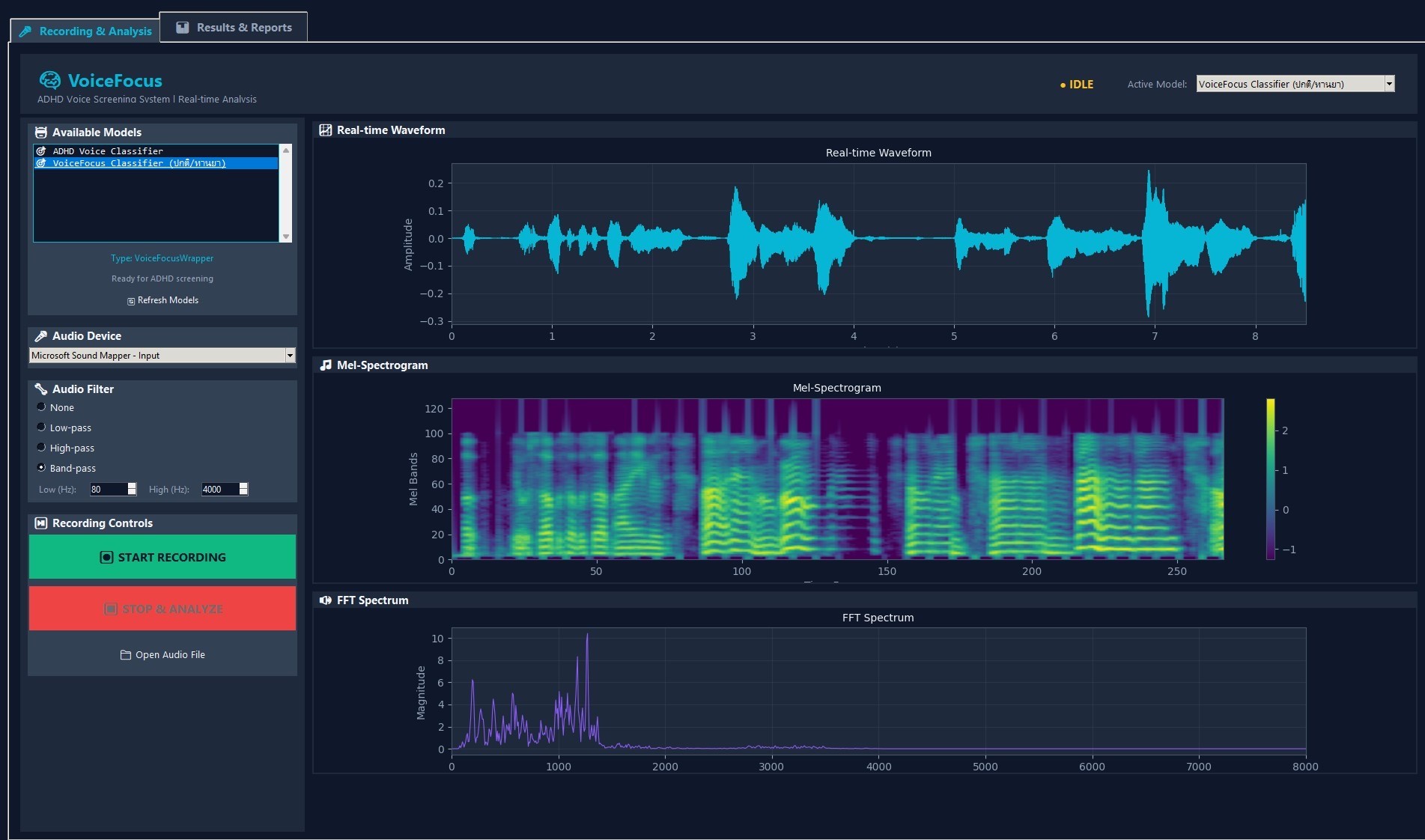
Band-pass filter (80–4,000 Hz) + extraction of Pitch Variability, RMS, ZCR, and Mel-Spectrogram.

3

AI Risk Analysis

Rule-based algorithm + Deep Learning designed specifically for Thai tonal speech patterns.

4

Report & Export

Real-time % Risk Score with Waveform and FFT Spectrum. Export session logs as CSV.

📸 Live Interface: Recording & Analysis

Real-time Waveform, Mel-Spectrogram, and FFT Spectrum displayed simultaneously as the system records Thai speech.

NeuroScreen Pro — Recording and Analysis Interface

Acoustic Intelligence

9 dimensions of speech analysis.

Nine acoustic features extracted from every Thai speech sample and used in the screening algorithm.

Pitch Variability

High-low pitch fluctuation: critical for Thai as a tonal language

Log-Mel Spectrogram

Energy-frequency-time representation for deep pattern recognition

FFT Spectrum

Full frequency component decomposition of the speech signal

RMS Energy

Average signal energy: captures loudness and vocal clarity of the speech signal

Zero Crossing Rate (ZCR)

Rate at which the signal changes sign: reflects speech frequency and energy variation

Signal Standard Deviation

Measures amplitude spread: higher std may indicate less controlled, more variable speech

Signal Variance

Square of std: captures the overall dispersion of signal amplitude across the recording window

dB Level

Decibel loudness measurement: also used for recording quality verification before analysis

Voice Pattern Similarity

Cosine comparison of std, rms, zcr, and pitch_var against stored Normal and ADHD reference templates

See It In Action

Watch VoiceFocus in action.

A short walkthrough of the recording, analysis, and reporting flow.

ยังไม่ได้ตั้งค่าวิดีโอ — เพิ่มลิงก์ YouTube ได้จากโหมดแก้ไข

Key Features

Built different.

🎯

Thai-First Design

Analyzes Pitch Variability and Tonal Contours specific to Thai: built from the ground up for Thai tonal language, not adapted from English-trained models.

📊

Quantitative Output

Continuous % Risk Score (0–100%), not color categories or Low/High labels. Clearer insight, better decisions.

Real-Time Processing

Live Waveform, Mel-Spectrogram, and FFT Spectrum visualization as you record.

🔒

Non-Invasive

Uses only natural speech. Works on any computer with a microphone.

🖥️

Accessible GUI

Designed for teachers and parents: no coding background required.

🔬

Multimodal-Ready

Architecture supports future EEG bio-feedback and Camera Motion Monitor integration.

📸 Results & Reports: Risk Score + Voice Pattern Comparison

After analysis, the system displays the ADHD Risk Level (%), confidence score, real-time voice metrics (Std Dev, RMS, ZCR, Pitch Var), EEG bio-feedback, and Voice Pattern Similarity chart — all in one view.

NeuroScreen Pro — Results and Reports with Risk Score
"VoiceFocus is not a diagnostic tool: it's a bridge that connects children to the right specialist, faster."
The VoiceFocus Team

Impact

The Earlier We Listen,
the More We Can Help.

🏫

Teachers & School Staff

Screen students in 1–5 minutes. Identify high-risk children for Individual Education Plans. Deployable across all public and private schools.

🏥

Nurses & Primary Care Workers

Support primary-level screening at district health centers. Use % Risk Score to determine referral urgency before sending to specialist hospitals.

👨‍👩‍👧

Parents & Caregivers

Preliminary home screening for children aged 6–12 via smartphone. Reduce anxiety and travel burden in 18 provinces with no child psychiatrists.

🔬

Researchers & Policy Makers

A foundational Thai speech dataset for Digital Biomarker research. Supports evidence-based policy on digital mental health nationwide.

In the Field

In the Field: Our School.

VoiceFocus is being developed and tested in partnership with a real school community in southern Thailand.

Recognition

Awards & Achievements.

VoiceFocus has been recognised at national academic and innovation forums. More to come.

✓ Poster Presentation
🎓

SHEE Siriraj Health Science Education Academic Conference 2026

Selected for Poster Presentation — Faculty of Medicine Siriraj Hospital, Mahidol University

2026 · Academic Conference

🏆 Finalist
🥇

Southern Inventors Award 2026

Regional innovation competition for student inventors in Southern Thailand

2026 · Finalist

⏳ Coming Soon
🌟

Add award / event name here

⏳ Coming Soon
🏅

Add award / event name here

⏳ Coming Soon
📜

Add award / event name here

⏳ Coming Soon
🎖️

Add award / event name here

✏️ Placeholder cards are ready for new awards. For each one, fill in: award name, organising body, year, and update the badge to Participated / Winner / Finalist as appropriate.

Understanding ADHD

About ADHD

Practical guidance for teachers and parents supporting children with ADHD — in the classroom and at home.

ADHD (Attention-Deficit/Hyperactivity Disorder) can appear in many different forms and often occurs together with other difficulties, such as learning disabilities or emotional problems. There is no simple solution for managing ADHD in the classroom or at home — success depends greatly on knowledge, consistency, and the right kind of support. The principles remain the same: structure, education, encouragement, and support.
🧩

Start with the Right Foundation

Make sure the difficulties are truly ADHD, not caused by hearing or vision problems. Seek support from specialists — child psychiatrists, school psychologists, or pediatricians. Know your limits and don't be afraid to ask for help. Teachers are not expected to be ADHD specialists.

🗣️

Ask the Child How to Help

Children with ADHD can often tell you what kind of help they need when asked. Try to speak with them privately. For older children, helping them understand what ADHD is can also be very useful. The best person to answer is often the child themselves — yet adults often overlook this.

📋

Structure Is Essential

Structure means the systems that help children control themselves because they may struggle to do so on their own. Timetables, to-do lists, and visible schedules help bring them back on track. They need reminders, guidance, repetition, and clear, consistent boundaries. Let the child write down rules and place them somewhere visible.

💓

Don't Forget the Emotional Side

These children need a classroom that feels enjoyable and makes them feel capable — not like failures. They need excitement more than boredom or fear. Often, the damage caused by low self-confidence is more serious than ADHD itself. Praise, encourage, and always help the child feel valued.

🔁

Repeat Instructions

Write instructions down and say them several times. Children with ADHD need repeated verbal reminders. Make eye contact often — it can help bring the child back from distracted thoughts and let them know you are paying attention to them.

🧱

Break Large Tasks into Smaller Ones

This is one of the most important strategies. When children with ADHD face a very large task, they may give up before starting. When broken into manageable parts, they gain confidence. For younger children, this reduces frustration. For older children, it reduces feelings of failure. Use this approach regularly.

🎮

Make Learning Feel Like a Game

Motivation helps a great deal. Be cheerful, simple, and humorous. These children are lively and playful — they dislike boring rules, schedules, and teachers. Show them that following structure doesn't have to be dull. Reward systems can also help control behavior, as they respond well to challenges and incentives.

🏃

Exercise and Movement Help

Exercise helps both children and adults with ADHD — especially intense exercise. It releases excess energy, improves concentration, and stimulates useful substances in the body. Allow occasional breaks and movement rather than restricting the child too much, which may cause them to disengage from the classroom entirely.

🤝

Work as a Team

Use a daily home–school–home communication notebook so teachers and parents can understand each other and provide consistent support. Meet with parents often — not only when problems occur. Set up a buddy system with a classmate who can help with learning. Involving the whole support network makes a meaningful difference.

🌟

Always Look for Strengths

Children with ADHD are often more intelligent than they appear. They can be creative, playful, and friendly. They are always trying to come back and keep fighting. Remember: these children have often experienced failure and need encouragement the way a thirsty person needs water. With it, they survive and grow.

📄 Translated from a Thai-language article by Asst. Prof. Dr. Pramote Sukonich

Source: https://www.rama.mahidol.ac.th/ramamental/generalknowledge/child/06132014-0853

Ramathibodi Hospital, Faculty of Medicine, Mahidol University — Department of Psychiatry

Why It Matters

The Economic Impact of ADHD.

Attention deficit hyperactivity disorder is a large economic burden on individuals, families, and society. Research shows that children with ADHD incur annual medical costs between $503 and $1343 more than their peers, while adults face costs as high as $5651 per year compared to $2711 for those without the condition. Families with members with ADHD can face up to double the per capita medical costs compared to unaffected families.

In rural Thailand, where pediatric specialists are expensive and limited, this problem is further exacerbated. The majority of children go undiagnosed, and never receive the support they require.

Our tool aims to change that.

A child records themselves reading a short script and uploads it to our algorithm. Our AI analyses speech patterns and provides a preliminary screening result, drastically lowering the barrier to early identification, without the need for specialist clinic visits, long diagnostic waitlists, or expensive professional assessments.

This reduces downstream costs. Untreated ADHD in childhood predicts lower educational achievements, unstable employment, and lower productivity in adulthood. Additionally, people with undiagnosed ADHD are also more likely to engage in criminal activity, with criminal costs alone averaging around $12,000 per person. Across a lifetime, a single undiagnosed case has downstream costs of around $80,000 - $100,000 in medical bills, lost earnings, and other societal costs.

This technology equalises access to early ADHD screening for underserved communities; faster flags, lower bills.

The People Behind It

Meet the Team.

VoiceFocus is built by students who believe technology should serve those who need it most.

-->

Get Involved

Help us bring VoiceFocus
to every child.

Interested in collaboration, research partnerships, or deploying VoiceFocus in your school? We'd love to hear from you.